

Automated carbon reporting: why audit controls matter

Scopes 1 and 2 are a known quantity. Your energy bills, your fleet, your facilities – contained, measurable, yours. Scope 3 is everything else: your suppliers, your contractors, your entire value chain. In most organisations, it accounts for 70 to 90 per cent of total emissions. It is also the category where most automated carbon reporting quietly breaks down.
The instinct is to automate – pull in supplier data, run it through the system, generate a number. But a number is not the same as a defensible figure. Without the right controls, automation does not solve the Scope 3 problem. It just makes the problem harder to see. You get a clean dashboard. You do not get confidence in what is underneath it.
Here is what that gap looks like in practice, and how eco-shaper is built to close it.
The real problem with scope 3 data collection
Scope 3 data collection is painful because you do not control the data. You are dependent on suppliers and contractors who each have their own reporting standards, their own methodologies, and their own levels of sustainability maturity. Some will give you primary activity data. Others will give you spend figures and leave you to estimate. Many will give you nothing at all.
The conventional workaround is spend-based proxies, taking a supplier’s invoice value and multiplying it by an industry emission factor to estimate their contribution. It is fast and it fills the gap, but it is also a significant source of inaccuracy. Spend-based estimates can be off by a factor of two to ten compared to activity-based figures. And as assurance requirements tighten, auditors are increasingly scrutinising the methodology behind Scope 3 numbers, not just the numbers themselves.
The data quality problem compounds further when you consider scale. A mid-size organisation might have dozens of suppliers contributing to material Scope 3 categories – for instance, a UK professional services firm with a distributed contractor network, or an Australian property portfolio operator with hundreds of subcontractors across sites. Managing that volume of supplier data manually – chasing submissions, checking formats, reconciling figures – is not a reporting process. It is a full-time job.
Where automation makes it worse, not better
The appeal of automated carbon reporting is obvious. Connect your systems, ingest your data, generate your report. But most automated systems are built around a silent assumption: that the data coming in is reliable. For Scope 1 and 2, that assumption is usually reasonable. For Scope 3, it almost never is.
When unaudited automation ingests supplier-reported figures without validation, it does three things that create serious risk:
It accepts bad data without flagging it. A supplier submits figures that are implausible – either too high or too low relative to their activity profile – and the system processes them without question. That error is now in your emissions inventory, attached to your name, ready to be disclosed.
It creates no accountability chain. Data flows from supplier to system to report with no named individual confirming it was reviewed. When your assurance provider asks who validated the Scope 3 figures, the answer is: the system did. That is not an answer that satisfies audit requirements, because anomaly detection by a collecting system does not constitute independent verification.
It gives you confidence you have not earned. A clean dashboard and a completed report feel like success. But if the data underneath has not been validated, reviewed, and confirmed by someone accountable, the confidence that dashboard gives you is false. The evidentiary question – whether a human with accountability reviewed and confirmed the output – remains unanswered.
The publish gate: Automation with a human accountability layer
eco-shaper is built around a core architectural principle that directly addresses this problem: the publish gate.
In most automated carbon reporting systems, data flows instantly from source to dashboard. Speed is treated as the point. At eco-shaper, we treat that instant flow as the problem.
The publish gate means that data does not propagate to the parent dashboard until a named individual within that entity has reviewed the submitted data, confirmed its completeness and accuracy, and actively published the period. Every published period carries a named individual, a timestamp, and a locked record. That is the accountability chain that external assurance processes require and that instant automation cannot provide.
For Scope 3 specifically, this changes the nature of what your supplier data means. Instead of figures that passed through a system, you have figures that a named person reviewed and confirmed. Instead of a black box, you have a documented, traceable record of who validated what and when. That is the difference between data that looks auditable and data that actually is.

How eco-shaper handles scope 3 data collection
Beyond the publish gate, eco-shaper’s supply chain engagement module is designed to address the specific mechanics of Scope 3 data collection at scale.
Activity-based data from suppliers, not spend-based proxies. Each supplier in your network is given access to their own carbon calculator within a secure, sovereign environment. They calculate primary activity data directly , energy use, fleet, waste, travel – rather than submitting spend figures for you to estimate from. That data is then sent to your master dashboard at the exact percentage of business attributable to your organisation, and mapped to verified emission factors. The result is Scope 3 figures grounded in actual activity, not approximation.
Validation before the data enters your inventory. Supplier submissions pass through eco-shaper’s validation layer before they reach your emissions inventory. Implausible figures are flagged for review. Gaps are surfaced rather than silently filled. Where estimation is required in line with GHG Protocol guidance, it is transparently recorded in the audit trail, not hidden inside an automated calculation.
A complete audit trail from submission to disclosure. Every Scope 3 figure in an eco-shaper report is traceable to its source, which supplier submitted it, which emission factors were applied, which individual confirmed it through the publish gate, and when. When your assurance provider examines your Scope 3 methodology, that documentation is already organised and accessible. There is no scramble to reconstruct a paper trail that was never built.
Employee activity data included as standard. Scope 3 categories 6 and 7, business travel and employee commuting – are frequently underreported because the data sits with HR systems and individual employees rather than with finance or operations. eco-shaper’s employee engagement module captures this data directly, combining it with company-level figures to give you a complete emissions picture without requiring manual consolidation across systems.
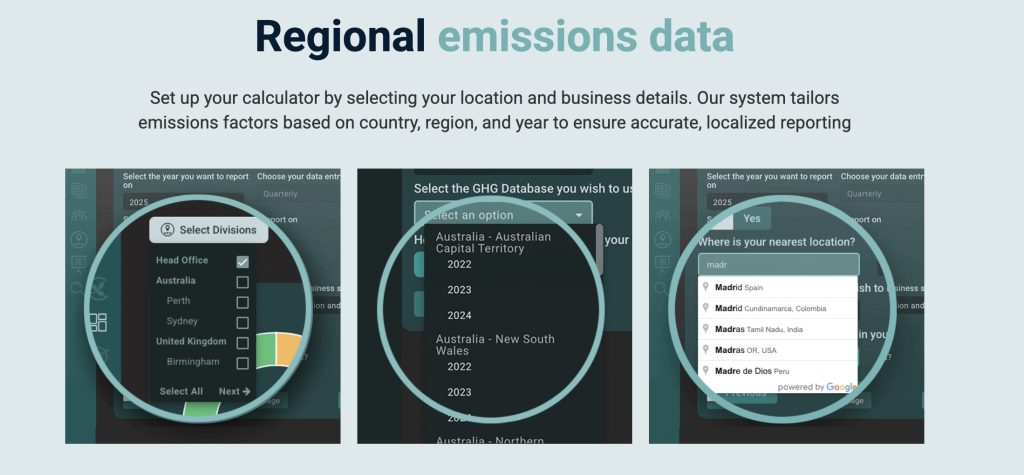
Regional emission factors maintained globally. eco-shaper’s regional emissions data capability embeds jurisdiction-specific emission factors for markets worldwide — including, for instance, National Greenhouse Accounts (NGA) Factors for Australia (updated annually in line with DCCEEW publication cycles) and the UK Government Conversion Factors for Company Reporting. You are not responsible for uploading or maintaining your own regional databases. The factors that underpin your calculations are current, jurisdiction-specific, and maintained by eco-shaper.
What this means in practice
A sustainability officer using eco-shaper does not have to choose between speed and defensibility. The zero-touch data automation handles the collection and processing burden. The publish gate, the validation layer, and the audit trail handle the accountability burden. Sprout, eco-shaper’s AI engine, surfaces reduction insights and net zero trajectory modelling from your verified data, so your strategic work is informed by figures you can stand behind.
The outcome is automated carbon reporting where the audit controls are not added on at the end. They are built into the architecture from the start.
Your Scope 3 figures should be defensible, not just done
If your Scope 3 reporting currently relies on spend-based proxies, manual supplier chasing, or automation that produces numbers you cannot fully stand behind – that is exactly the problem eco-shaper is built for.
See the publish gate and supply chain engagement tools in a live demonstration, and bring your own reporting workflow. We will show you specifically where the accountability gaps are and how the platform addresses them.

Be a net-zero hero
At eco-shaper, we drive action on climate change and streamline carbon footprinting. For example, we can help calculate emissions across the entire ecosystem that companies work across and produce automated reporting based on outcomes. Contact us to be part of our research group on lucy@eco-shaper.com
